Pandemic nightmares in pregnancy
Or, why two years to flatten the curve is a public health disaster.

It was 3:30 AM, and I gradually realized that I had been having a nightmare. Dr. Bonnie Henry, BC’s Provincial Health Officer, had announced a publicly searchable database of the unvaccinated; starting with all BC Public Servants, but to be rolled out for the entire provincial population. It would be a way for the vaccinated—the righteous—to feel safe; empowered with agency over what type of people they associate with over Christmas. The reaction of the BC Privacy Commissioner, BC Human Rights Commissioner, and BC Civil liberties Association? A collective shrug. The courts have established that Public Health Officials, after all, shouldn’t be “second-guessed” (see 292), even using judicial notice to cement government opinions as indisputable. Far from waking to a reassuring sense of reality, instead I awoke perturbed. I waddled my squirming unborn baby and full bladder to the bathroom, and sat on the toilet thinking, “She wouldn’t… would she?”
This week, after the world’s leaders returned to their home nations following the UN Climate Change Conference, Austria announced a limited house arrest (or “lockdown”) on those who committed no crime, but who instead opted out of a government-sponsored pharmaceutical campaign for what is now called a vaccine. The “vaccine” was designed to prophylactically lessen symptoms of Covid-19, and did not meet the definition as recently as August, so the definition was changed. In an interview with Freddie Sayers, Austrian political scientist Ivan Krastag said that the difference between classical Austrian authoritarianism of 1938, which also wielded science to justify false public health fears and related measures, is that historically Jews were not given an option to integrate, whereas the “dream of the government” today is for the unvaccinated to become vaccinated. Had Jewish Europeans been given the option to “de-Jew” themselves; would that make the pseudo-scientific measures against them a crime of their own making?
Professor Manfred Nowak, human rights lawyer and Secretary General of the Global Campus for Human Rights, said that Austria’s measures were proportional, apparently still believing the unvaccinated are somehow holding the vaccinated back, and that the utopian consensus to tackling Covid-19 was broken not by scientific advancement, but by right-wing shit-disturbers with nothing better to do. Nowak said that punishment for the unvaccinated is better than a direct approach of mandatory vaccination, which he conceded would be a human rights abuse. Five days later, Austria expanded lockdown to the vaccinated and mandated vaccination as a legal requirement.
This may be the start of a chorus of nations, following the global climate conference, to collude on sanctions against citizens who don’t conform to the pharmaceutical industry’s solution to Covid-19. After Austria announced house arrest for the unvaccinated, Germany banned unvaccinated people from public transit. But what about here? What about British Columbia?
Dr. Bonnie Henry was asked if she would follow Austria’s lead. Her answer? It’s not off the table. Not that it would matter, since Dr. Henry gave the concept of vaccine passports a Hard No in May, saying there was “no way that we will recommend inequities be increased by the use of things like vaccine passports … and I’ve got the support from the Premier,” only to announce their imminence in August.
It’s reasonable to think that a novel virus necessitates flexible responses. Perhaps authorities placate the public with one promise, but the severity of the situation compels them to renege. That seems to be the public’s preferred explanation, but it doesn’t actually make sense. While Dr. Bonnie Henry’s Provincial Health Orders state that vaccine passports are time-limited for five months (subject to extension, of course) and will be reviewed periodically to ensure their continued relevance, the scientific justification for their application has been waning at pace with the vaccinated population’s immunity.
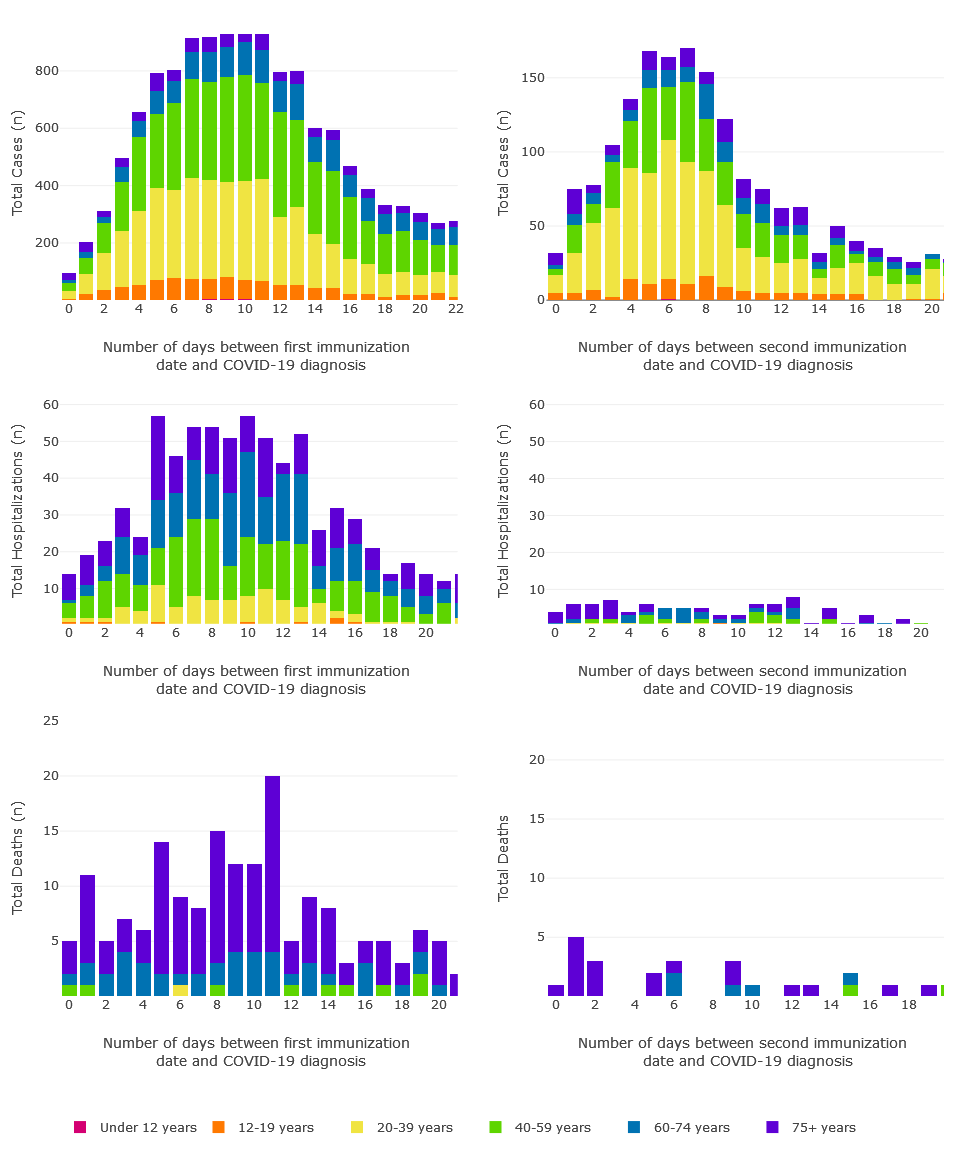
Dr. Bonnie Henry, standing beside Health Minister Adrian Dix, pedalled the “pandemic of the unvaccinated” narrative, citing higher hospitalizations and deaths among unvaccinated citizens than vaccinated ones. In other words, the unvaccinated were tying up health care resources because of their decisions (never mind that public health has never been about public shaming of patients for illnesses of their own negligence; like HIV-AIDS, heart disease, lung cancer, or type II diabetes). This was despite Alberta’s provincial data, which continues to show a major spike in cases, hospitalizations, and deaths in the first 21 days after receiving a first dose (Figure 12).
Of course, these were classified as “unvaccinated”, implying to the media-consuming public that those hospital resources were taken by “the selfish” rather than those who “did their part”. Meanwhile, a pre-print study, conducted over eight months in 2021, found that vaccinated patients had “lower odds” of ICU admission (14.25 vaccinated for every 25 unvaccinated patients), but there was “no difference in the length of stay for patients not admitted to ICU, nor odds of in-hospital death between vaccinated and unvaccinated patients.”
The other justification for vaccine passports was the assumption that the vaccines prevented infection and transmission; and therefore, that to remain unvaccinated was to put others at risk. While we know that these vaccines confer a time-limited reduction of severe symptoms in the lower respiratory system, we also know that they do not prevent infection, nor transmission. We also know that vaccinated and unvaccinated people carry the same peak viral loads, and that these vaccinations bestow a level of systemic immunity (that is, the internal workings of the lower respiratory system) but not necessarily mucosal immunity (in the upper airways, where Covid-19 transmits). That is why vaccinated people are just as likely to transmit the virus as unvaccinated people; but vaccinated people are less likely to know that they’re infected.
So, the goal post was moved again, now Fact-Checkers are running backwards to rehash obsolete 2019 data on vaccine effectiveness for the original gangster Covid rather than peer-reviewed data on today’s almost ubiquitous Delta variant, and arguing that a pre-print study shows vaccination shortens an infectious period (inferred from the Ct value, or cycle threshold, of a positive PCR test) and therefore limits the period for which transmission can occur. Manitoba’s Chief Microbiologist and Laboratory Specialist Dr. Jared Bullard testified that viral Covid-19 samples with a Ct value over 25 could not be replicated, and are therefore thought to be non-infectious. Vaccinated individuals in the pre-print study reached a Ct value of 25 on day 7, whereas unvaccinated individuals reached a Ct value of 25 on day 9: a difference of two days.
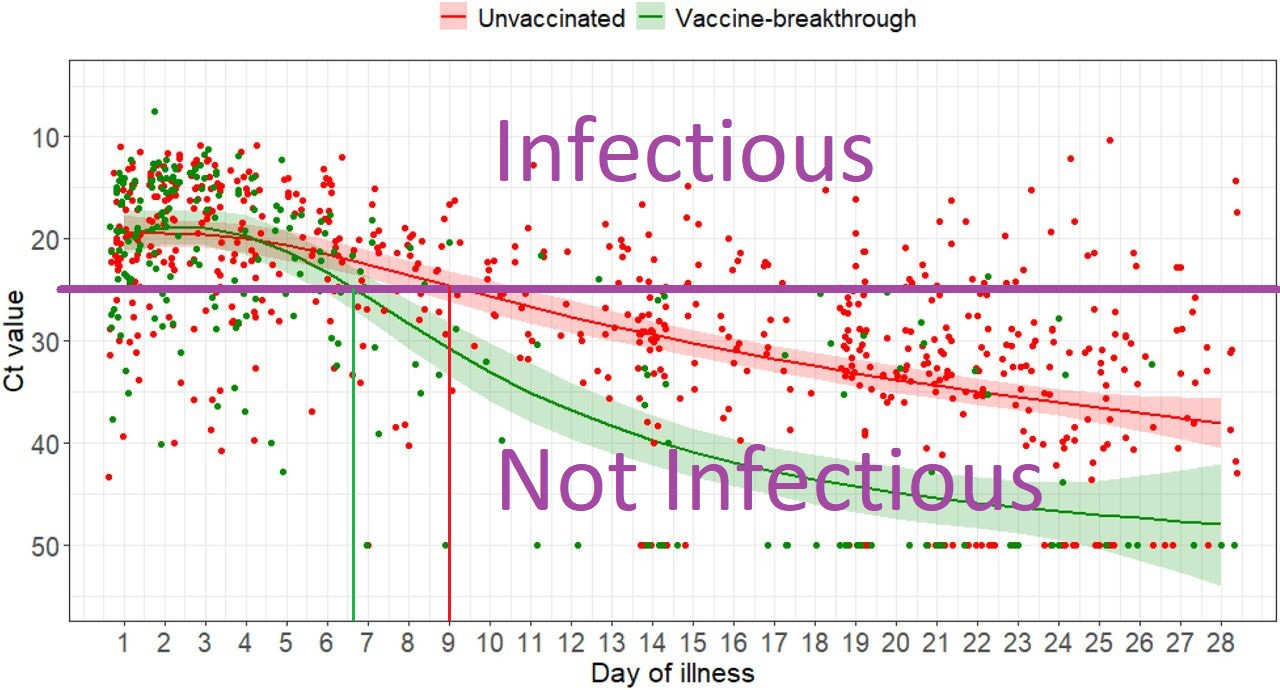
Are we really locking mostly healthy, non-infected people—who are just as likely to contract a disease as a vaccinated person—out of our community because they might transmit the disease for 2 days longer than a vaccinated individual would? How do these measures continue to be justified? Perhaps more importantly, why are they becoming more severe when the data behind them is disintegrating before our eyes? Is it because of public health, or public hate?
It is as if our public health officials are petulant children, digging their heels deeper into the ground, grasping with all their might at the door jamb of yesterday’s science. “I don’t wanna go, mommy!” But far be it from me, some pregnant insomniac with no medical degree, to “second guess” public health authorities. Surely there is someone who works in medicine, human rights, privacy, or civil liberties who is willing to go to bat for what used to be their principles. Surely there is some group out there who hasn’t been hypnotized by the mythical and infallible public health office; someone who remembers that even doctors make mistakes, and that ranking faulty science over human rights needs to be reined in from time to time.
Surely, I can relax knowing that my nightmare was … just a dream.